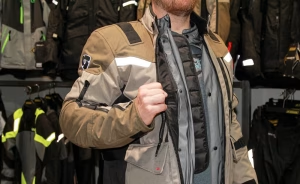
Are textile jackets safe on highways? Are mesh jackets safe at speed? Real abrasion data, slide distances, women's fit gaps, and honest material safety comparison.
Table of Contents
Safest Motorcycle Gear for Highway Riding: What Actually Protects You at Speed?
Nobody thinks they’ll crash. Then they do — usually at the worst possible speed on the worst possible road. The gear you picked for looks or comfort is suddenly the only thing between your skin and tarmac moving at 60mph. That moment is too late to make a better decision.
This is what each material actually does when it matters.
How Motorcycle Gear Protection Actually Works
Before comparing materials, understand what gear is protecting you from — because impact and abrasion are two completely different forces and most gear handles one better than the other.
Abrasion happens during the slide. Your body contacts the road surface and travels across it. The gear needs to stay intact long enough to protect the skin underneath. Time on the road surface — measured in seconds — is what determines whether the material works or fails.
Impact happens at the moment of contact. Armor absorbs and distributes the force hitting a joint or bone. The outer shell material is mostly irrelevant here — armor quality and placement determine impact protection, not whether the jacket is leather or mesh.
Most riders buy gear thinking about one and ignoring the other.
Are Mesh Jackets Safe at Highway Speeds
Mesh jackets are safe at urban speeds with proper armor. At highway speeds the answer changes.
At 60mph a 600D polyester mesh panel holds up for three to four seconds of road contact before abrading through. That sounds like enough time. It isn’t — a typical low-side at 60mph involves four to seven seconds of sliding depending on road surface and body position. The mesh is gone before you stop moving.
What this means practically:
Urban riding under 50mph — mesh with 600D panels and proper armor is a reasonable choice
Motorway riding above 60mph — mesh outer panels will not last the full slide
Any speed above 70mph — mesh is not the right primary protection for the outer shell
The armor inside a mesh jacket still works regardless of what the outer shell does. Impact protection at the shoulders, elbows, and back functions independently of the fabric. The problem is abrasion — skin exposure once the mesh panel fails.
Are Textile Jackets Safe on the Highway
Yes — textile is the most practical safe option for highway riding that isn’t leather.
Cordura 600D textile holds up for five to eight seconds of road contact at 60mph. That covers most real-world slide distances at motorway speeds. The outer shell survives, the armor stays in position, and the membrane underneath adds a secondary layer between the Cordura and your skin even after the outer surface abrades.
Textile also handles the impact side correctly — armor pockets are typically more structured in textile jackets than in mesh, keeping protectors positioned correctly through the slide rather than shifting as the jacket distorts.
What makes a textile jacket genuinely highway-safe:
Cordura 600D minimum on outer panels — lighter Oxford weave fabrics perform closer to mesh
Structured armor pockets that hold protectors in position under distortion
Full back protector included — not just a pocket for one
Sleeve and waist adjusters that keep the jacket fitted at speed rather than lifting
Are Kevlar Jeans Any Good for Highway Riding
For lower body protection on highways, Kevlar jeans are significantly better than regular trousers and significantly worse than proper textile or leather riding pants.
The aramid lining handles abrasion well — DuPont Kevlar fiber tests at five to seven seconds at 60mph for lined panels. The problem is coverage. Most Kevlar jeans only line the knee and hip panels. The thigh, calf, and seat are often standard denim — which abrades through in under two seconds.
Full-leg Kevlar lining changes this considerably. If the aramid covers the entire leg rather than just the impact zones, the protection profile improves to the point where Kevlar jeans become a legitimate highway option for lower body.
For highway riding specifically:
Knee-and-hip-only Kevlar jeans — better than denim, not adequate above 60mph
Full-leg Kevlar lining — adequate for highway speeds in most crash scenarios
Paired with a textile jacket — a complete system that covers both abrasion and impact across the full body
Textile vs Mesh Safety — The Direct Comparison
Mesh 600D
Textile Cordura 600D
Abrasion time at 60mph
3–4 seconds
5–8 seconds
Survives full highway slide
Unlikely
Usually
Armor positioning under distortion
Moderate
Strong
Impact protection
Depends on armor quality
Depends on armor quality
Safe speed range
Up to 50mph urban
Up to motorway speeds
Weather protection
Minimal
Strong
The gap between mesh and textile at highway speeds is not marginal. It is the difference between the outer shell surviving the slide and it not surviving.
Mesh vs Perforated Leather — Which Is Safer in Summer
Perforated leather is the answer most riders don’t consider when the choice feels like mesh or sweat.
Perforated leather at 1.0mm to 1.2mm thickness handles abrasion for eight to twelve seconds at 60mph — significantly beyond both mesh and textile. The perforations reduce heat retention and allow airflow without reducing the structural integrity of the hide. You lose some breathability compared to full mesh but gain abrasion protection closer to solid leather.
In temperatures above 28°C where a textile jacket becomes uncomfortable:
Mesh — maximum airflow, lowest abrasion protection
For summer highway riding specifically, perforated leather outperforms mesh on safety without the full heat penalty of solid leather.
Single Crash vs Multiple Crash Survivability
This distinction matters for long-term safety decisions.
Leather — a minor slide may leave the jacket repairable and wearable. The hide compresses and abrades at the surface but the structure underneath often survives. One jacket can protect through more than one incident.
Textile — Cordura outer abrades and the jacket shows visible damage but the inner construction frequently survives a first crash intact. Repairable in most cases after a minor slide.
Kevlar jeans — aramid lining compresses permanently after significant abrasion contact. The outer denim is destroyed. The lining looks intact but the fiber structure has changed. Replace after any real crash regardless of appearance.
Mesh — single crash material above 50mph. The outer panels are gone. The jacket is not repairable in any meaningful protective sense after a highway slide.
Kevlar Jeans Women’s Safety — The Fit Problem Nobody Addresses
Women’s motorcycle gear safety is not just about material — it is about whether the material is in the right place on a female rider’s body.
Most Kevlar jeans are patterned on male proportions. The knee panel sits at the correct position for a male inseam length. On a shorter female inseam, that same panel sits above the actual knee — protecting the lower thigh while leaving the kneecap exposed.
The same problem applies to hip panels. Female hip-to-waist ratio places the hip bone at a different position relative to the waistband than male anatomy. A hip panel positioned for male proportions frequently sits too high or too low on a female rider.
What women buying Kevlar jeans need to check:
Sit on a bike or assume riding position before confirming fit — not standing position
Knee panel must center on the actual kneecap in riding position
Hip panel must cover the hip bone — not the upper thigh or waist
Inseam length affects panel position more than overall size — short inseam riders need jeans patterned for shorter leg proportions
At Saribco Industries, women’s motorcycle pants and Kevlar-lined builds are cut on dedicated female pattern blocks — not scaled from men’s patterns. The armor pocket positioning is adjusted for female rider anatomy specifically because the difference in protection between a correctly positioned panel and a mispositioned one is not marginal.
Style vs Protection — Where Riders Get This Wrong
The style versus protection trade-off is real but most riders misunderstand where the trade-off actually sits.
Buying a mesh jacket because it looks better than a textile jacket is a style choice that costs you abrasion protection at speed. That is a legitimate trade-off if you understand it.
Buying Kevlar jeans because they look like regular denim is not a style trade-off — it is getting protection in a form that works in normal life. That is a genuine advantage, not a compromise.
The problematic trade-off is buying gear that looks protective without being protective — heavily branded mesh jackets with thin panels, low-denier Cordura sold as full protection, or Kevlar jeans with minimal lining coverage marketed as full leg protection.
Gear should match the riding it’s used for. Highway riding above 60mph needs textile or leather outer shell minimum. Urban riding under 50mph allows more flexibility. Mixing those requirements — highway speeds in urban gear — is where the style versus protection trade-off stops being a personal choice and becomes a safety decision with real consequences.
Kevlar jeans in hot weather, mesh vs perforated leather heat, textile vent timing, UV damage on fibers — everything hot climate riders need to know before summer riding.
Textile jacket repair, zipper replacement, armor pocket fixes, and leather patching — what you can fix, what you can’t, and what it costs versus buying new.
Are textile jackets safe on highways? Are mesh jackets safe at speed? Real abrasion data, slide distances, women’s fit gaps, and honest material safety comparison.
Can you wear a mesh jacket in winter? Yes — if you layer correctly. Wind chill math, thermal base layers, liner compatibility, and what to wear under a textile jacket explained.
Step-by-step washing guide for Kevlar jeans, textile jackets, and mesh gear. Armor removal, detergents to avoid, drying methods, and how to stop membrane damage before it happens.
Mesh, Kevlar jeans, textile, or leather — which actually lasts longer and costs less per year? Real lifespan data, cost-per-year math, and material comparison no one else covers.